
API Architecture Styles Made Simple
(6 Minutes) | How Each Works, Benefits, Tradeoffs, and When to Use Each (and When Not to)


Build AI Apps with MongoDB
Presented by MongoDB

Looking to stay ahead of the curve on AI? MongoDB AI Learning Hub has the technical training pathways and tools you need to level up your AI app-building game. Explore practical guides, tutorials, and quick starts for all skill levels, from foundational concepts like understanding AI tool stacks to advanced implementations using RAG, Atlas Vector Search, and LLM optimization.
API Architecture Styles Made Simple
Most API pain doesn’t come from bad code.
It comes from choosing an API style that doesn’t fit the problem.
REST starts to feel slow when every screen needs five endpoints. GraphQL becomes heavy when all you wanted was simple CRUD. gRPC ties clients too tightly when the real consumers are browsers. WebSockets add complexity for features that barely need real-time updates.
Most teams only notice this mismatch once something hurts.
The root cause is almost always the same: the team reached for the tool they knew, not the one the problem needed.
The way forward is simple: understand each architecture style so you can choose the one that fits your use case.
REST
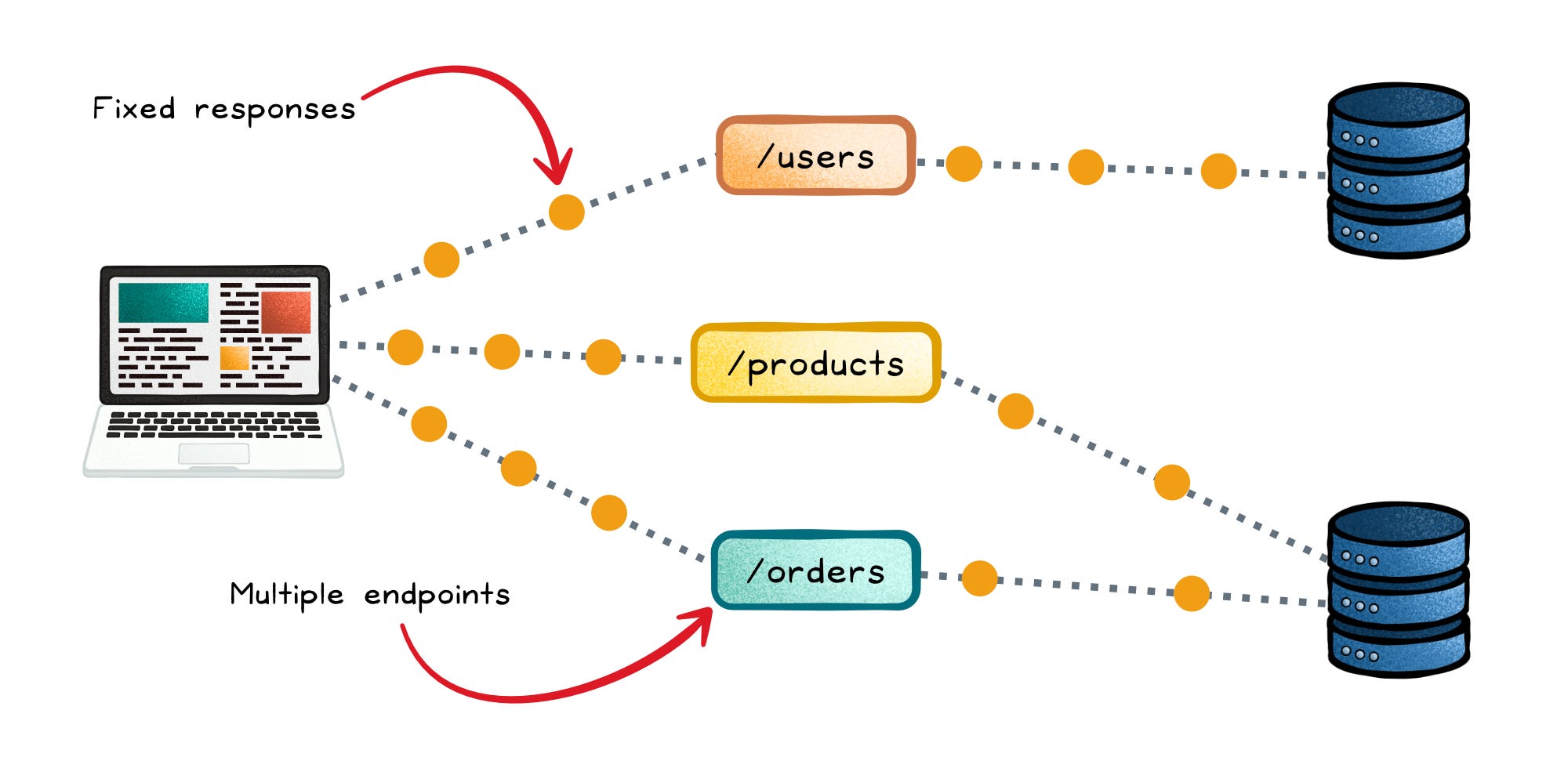
REST works well when your domain maps cleanly to resources.
You expose URLs, apply HTTP verbs, and let the web do the heavy lifting.
Reads become simple, cache-friendly operations that scale because intermediaries already understand the pattern.
REST performs best when clients want whole resources rather than tailor-made responses.
Problems start when pages need fragments from many endpoints. The client ends up over-fetching, under-fetching, or chaining calls in ways the architecture never intended.
Pros
Predictable structure → Resources map cleanly to URLs and verbs.
Strong caching → GET responses reuse CDN and browser caches.
Loose contracts → Adding fields or links rarely breaks clients.
Cons
Chattiness under load → Complex pages require many round trips.
Rigid shapes → Clients cannot trim or reshape responses easily.
Hard joins → Combining related data requires custom endpoints.
REST isn’t a good fit when your UI needs tailored data from many related resources. If every screen forces the client to stitch together multiple endpoints, you’ve outgrown the resource model.
GraphQL
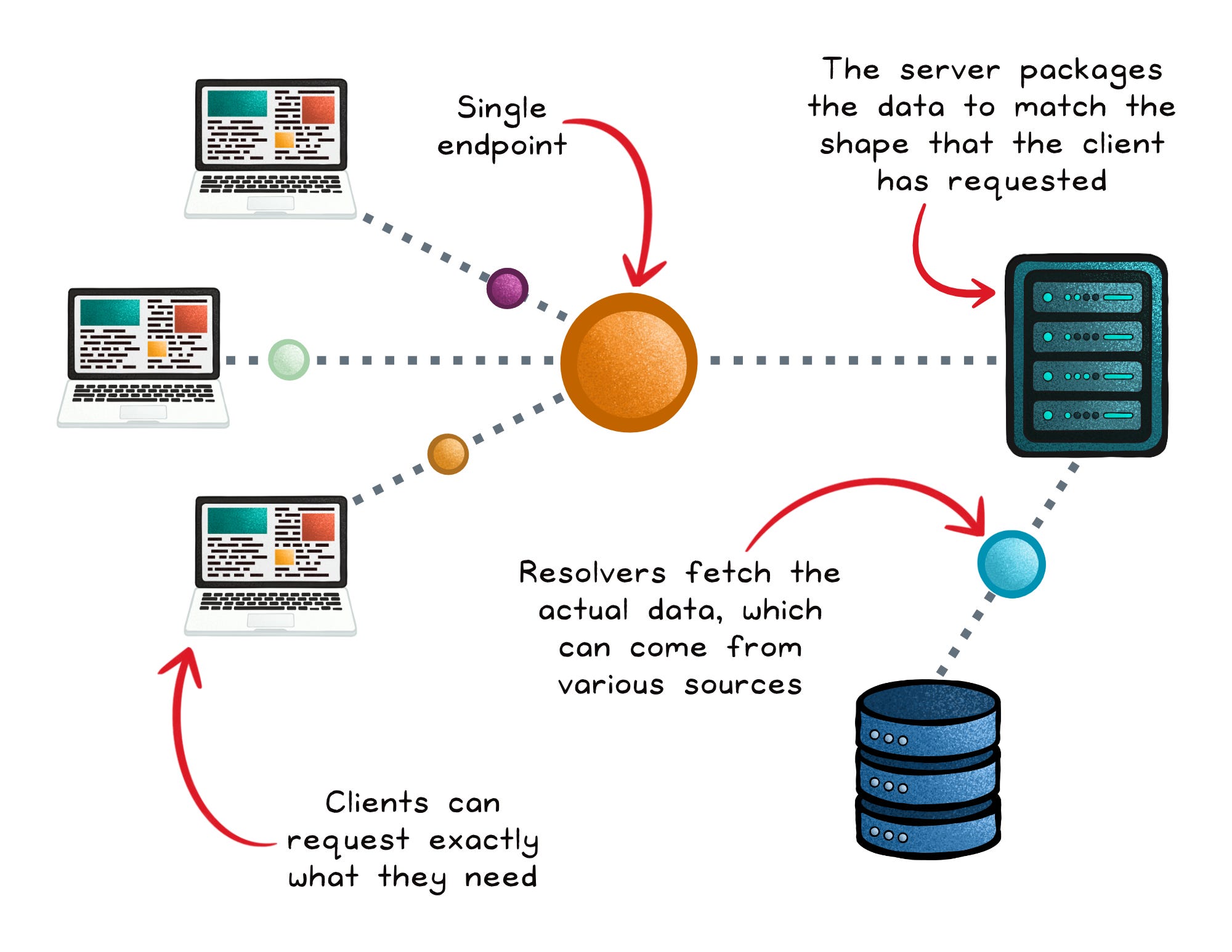
GraphQL lets the client define the shape of the data it wants.
One query pulls from multiple related objects, which makes dashboards and complex pages faster and easier to build. The schema becomes the contract, and tooling grows around it automatically.
The trade-off is operational complexity.
You must govern the schema and control resolver behavior. Without those guardrails, a single expensive query can take down the system.
Pros
Client-defined shapes → No over-fetching or under-fetching.
Single endpoint → Reduces coordination for clients.
Strong schema → Introspection and tooling improve developer experience.
Cons
Operational overhead → Query cost controls and caching are nontrivial.
Harder caching → Traditional HTTP cache layers become less effective.
Complex joins → Poor resolver design can lead to N+1 performance issues.
GraphQL becomes the wrong tool when you don’t need flexible queries or when your caching strategy leans heavily on simple HTTP semantics.
If your team can’t support the operational overhead (resolvers, query limits, schema governance) it will slow you down more than it helps.
gRPC
In an RPC model, an API exposes operations like GetUser instead of URLs. You call a method with typed inputs, and the server returns typed outputs.
It feels like a local function call even though it travels over the network.
gRPC standardizes this pattern.
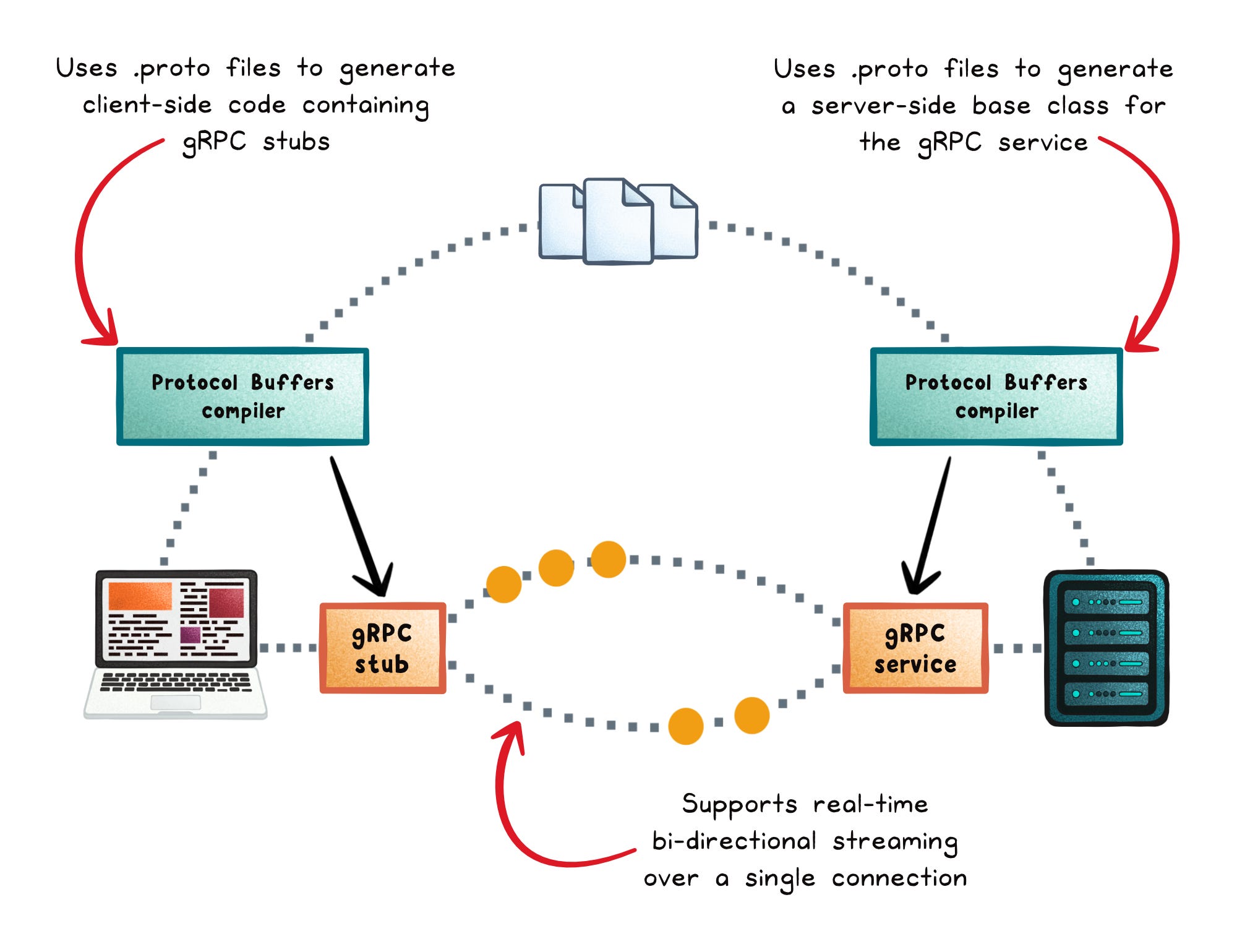
You define your data and API methods in a .proto file. gRPC turns that file into ready-made clients and servers, letting you call functions directly without building any HTTP logic yourself.
This design performs well inside microservices.
Protobuf keeps payloads small. HTTP/2 streams requests efficiently. And the strong typing helps teams evolve systems without guesswork.
The trade-off is tight coupling: clients depend on specific method names and message shapes, so any change needs to be intentional.
Pros
Typed contracts → .proto files define messages and operations clearly.
High throughput → Protobuf and HTTP/2 reduce overhead.
Generated clients → No manual HTTP plumbing.
Streaming support → Efficient for continuous or large data flows.
Cons
Tight coupling → API changes require careful coordination.
Limited browser support → Needs gRPC-Web or a REST/GraphQL layer.
Harder inspection → Binary payloads need tooling to debug.
gRPC is a great internal API style, but not great for browser-first public APIs. Browsers don’t speak it natively, and most external consumers expect REST or GraphQL.
WebSockets
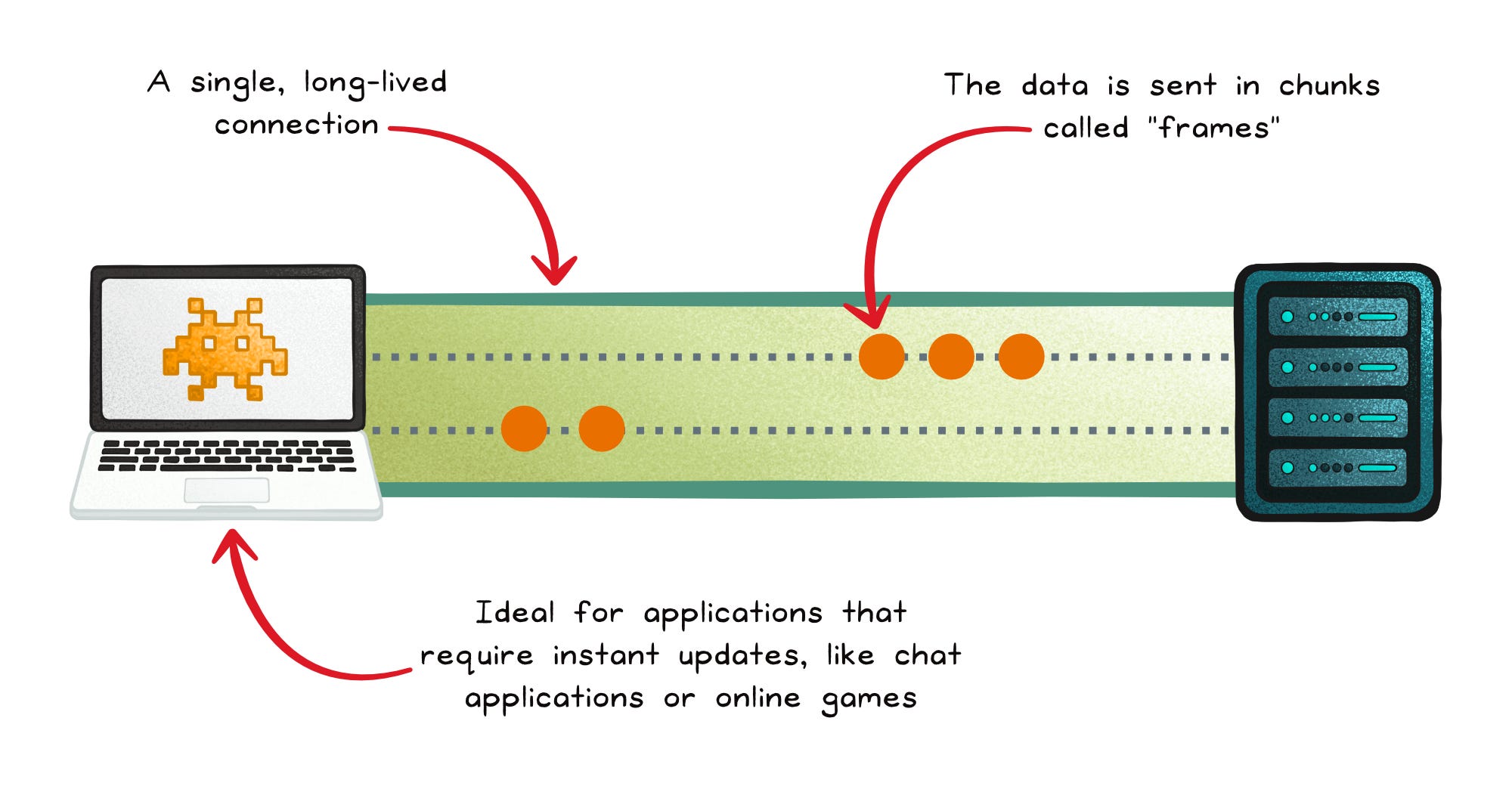
WebSockets provide a persistent two-way channel.
After the handshake, client and server can send messages whenever they need to. That makes WebSockets ideal for real-time features like chat, multiplayer games, live dashboards, and collaborative documents.
The difficulty lies in scale. Every open connection consumes memory, requires liveness checks, and pushes state deeper into your infrastructure.
Pros
Low latency → Updates arrive as soon as they happen.
Bi-directional flow → Both sides push events on demand.
Great for collaboration → Synchronizes state across many clients.
Cons
Stateful infrastructure → Harder to scale horizontally.
Connection management → Heartbeats, retries, and backpressure required.
Higher complexity → More failure modes than stateless HTTP.
WebSockets aren’t worth the complexity when updates are infrequent or latency isn’t critical. If a simple polling loop or server-sent events meet your needs, a persistent stateful connection only adds operational weight.
SOAP
SOAP prioritizes guarantees.
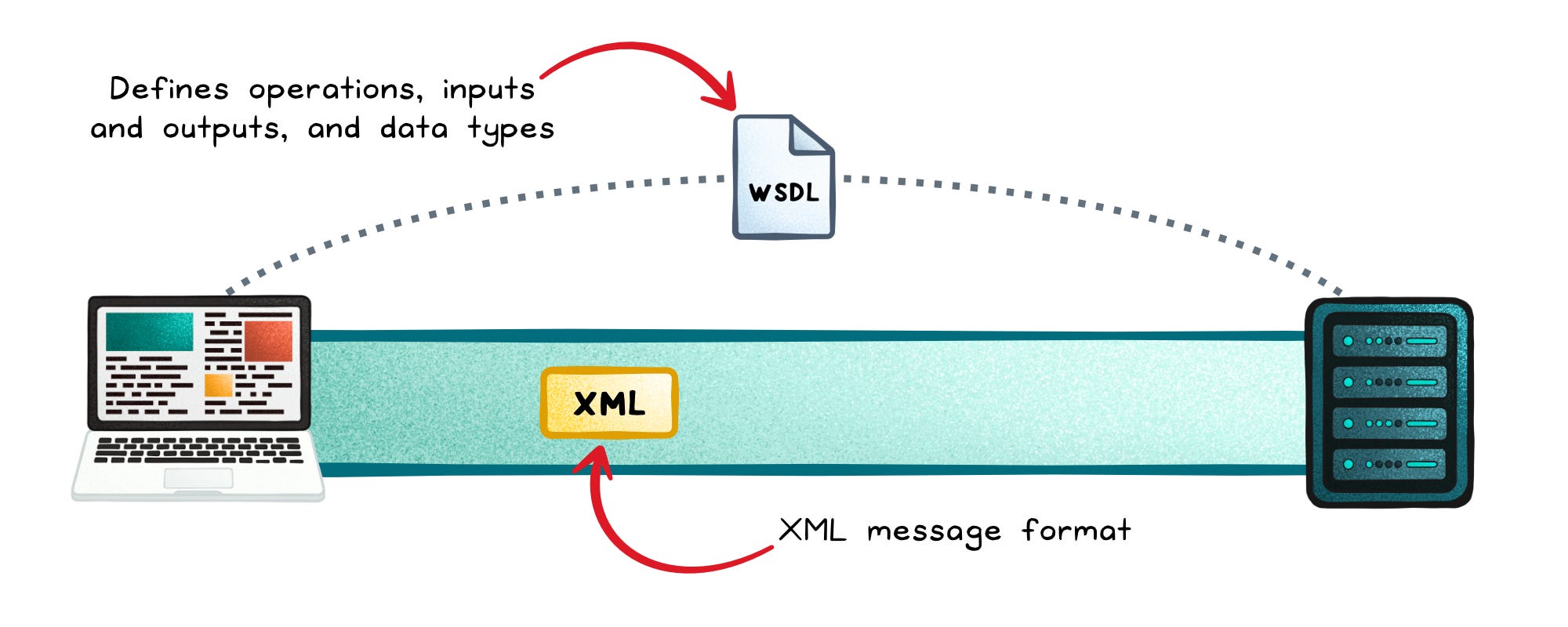
It standardizes XML messages, WSDL contracts, and WS-* extensions for security, reliability, and transactions.
These features matter in domains where correctness outweighs simplicity.
But the overhead is significant. SOAP is verbose, complex, and overkill for most modern APIs. However for regulated industries or legacy systems, it provides more standardized guarantees and tooling in certain enterprise ecosystems.
Pros
Strong contracts → WSDL defines exact operations and data types.
Enterprise-grade guarantees → Security and message reliability built in.
Widely supported → Works across heterogeneous enterprise systems.
Cons
Verbose payloads → XML and WS-* add significant overhead.
High complexity → Harder to build, debug, and evolve.
Poor fit for modern apps → JSON and REST provide simpler alternatives.
SOAP is the wrong choice for modern web or mobile APIs where lightweight JSON and simple HTTP patterns work better.
Unless your environment requires WS-* guarantees or must integrate with legacy systems, the overhead isn’t justified.
Choosing the Style That Fits
No API style is “the best”.
Each one solves a different shape of problem, and each one breaks when used outside that shape.
The wins come from matching the style to the job: resources to REST, flexible queries to GraphQL, high-speed service calls to gRPC, live interactions to WebSockets, and strict guarantees to SOAP.
A simple way to make that call is to look at what each style optimizes for:
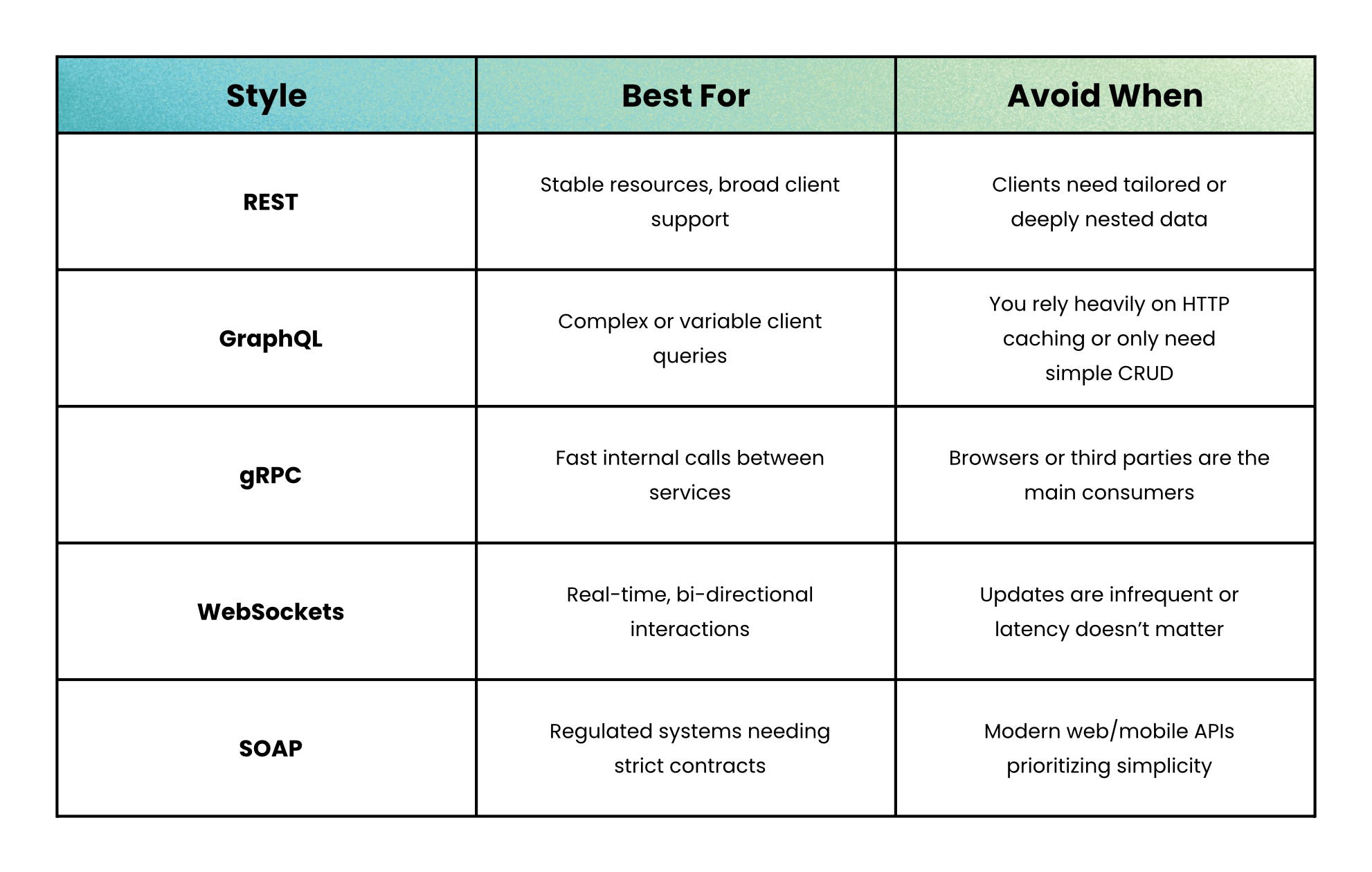
Once you understand these boundaries, the decision becomes clearer: pick the style that matches your use case, not the one you used last time.
The more intentional you are here, the easier your system becomes to scale, evolve, and reason about over time.
👋 If you liked this post → Like + Restack + Share to help others learn system design.
Subscribe to get high-signal, visual, and simple-to-understand system design articles straight to your inbox: