
Microservices Clearly Explained
(4 minutes) | The benefits are real. The distributed complexity is too.


Microsoft Foundry: The AI App and Agent Factory
Presented by Microsoft

Most teams can spin up Al demos. Far fewer can run agents reliably in production.
Microsoft Foundry is a unified Azure platform for building, optimizing, and governing Al agents at scale. It brings the widest selection of models on any cloud, data, multi-agent workflows, observability, and security controls together in one interoperable system, so teams can move faster without sacrificing openness, control, or security.
Microservices Clearly Explained
Microservices are not “small monoliths.”
They change how software is built, deployed, and owned; for better and for worse.
Teams adopt them to move faster and scale more precisely, then discover they’ve also signed up for distributed complexity.
Knowing where that trade-off helps, and where it hurts, is what determines success.
What microservices really are
A microservices architecture structures an application as a collection of small, independent services.
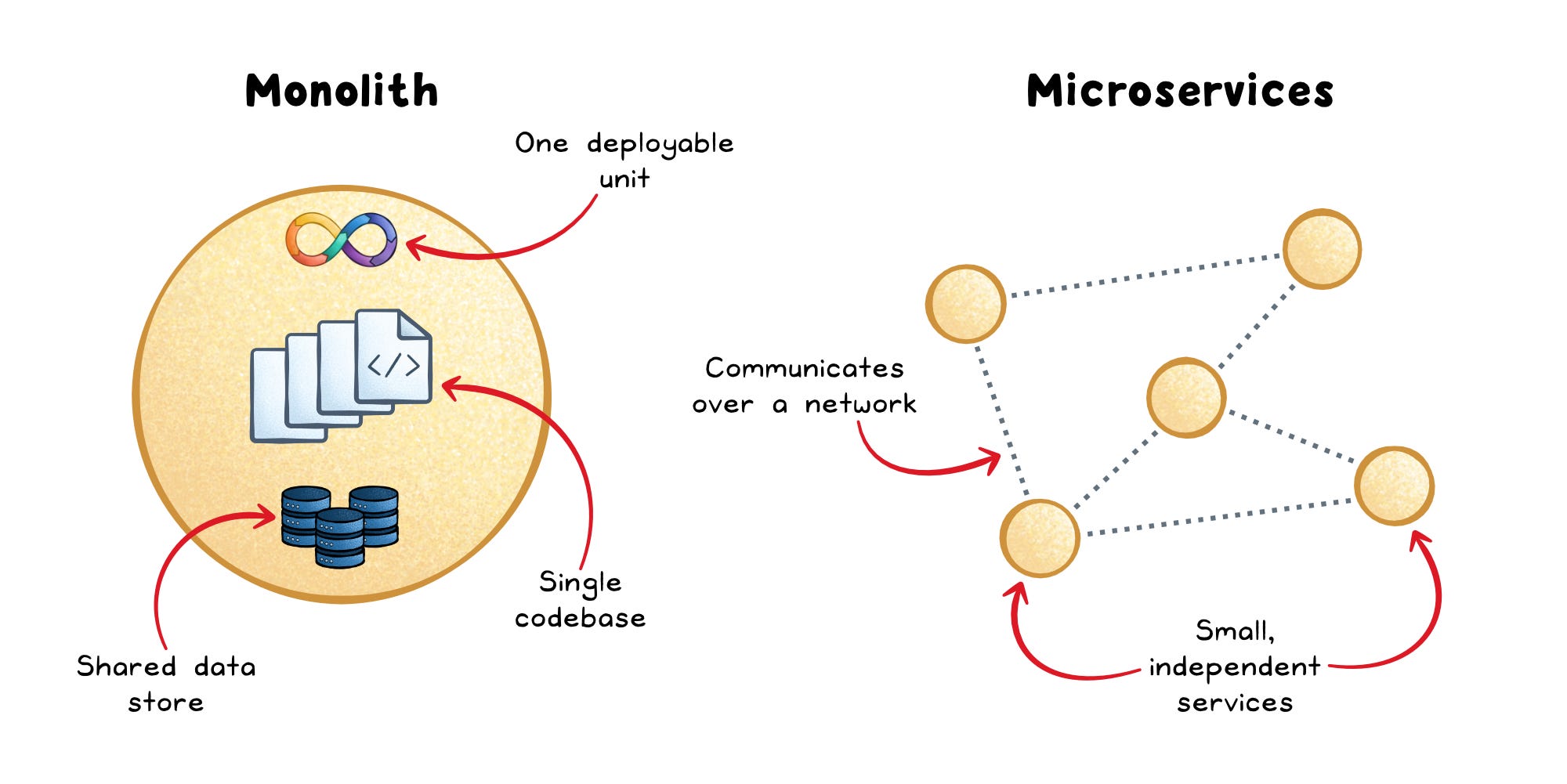
Each service owns a single business capability, runs in its own process, and communicates with others over a network; usually HTTP APIs or asynchronous messaging.
The key distinction is not size. It’s ownership and independence.
Each service maps to a real domain like payments, orders, or inventory
One service can deploy independently
Each service manages its own database or storage
Instead of one large codebase and database, you have many smaller ones that cooperate.
Updating a payment service no longer risks breaking user profiles. Scaling search traffic no longer forces you to scale checkout.
How microservices work in practice
In a microservices system, a single user action involves multiple service interactions.
Placing an order may trigger a chain of calls: inventory checks, payment authorization, order creation, notifications. These calls happen over HTTP or via asynchronous messages rather than in-memory function calls.
To make this all work, most systems introduce supporting infrastructure:
An API gateway routes requests and hides internal structure
Service discovery helps services find each other at runtime
Message brokers decouple producers from consumers
Centralized logging and tracing reconstruct request paths
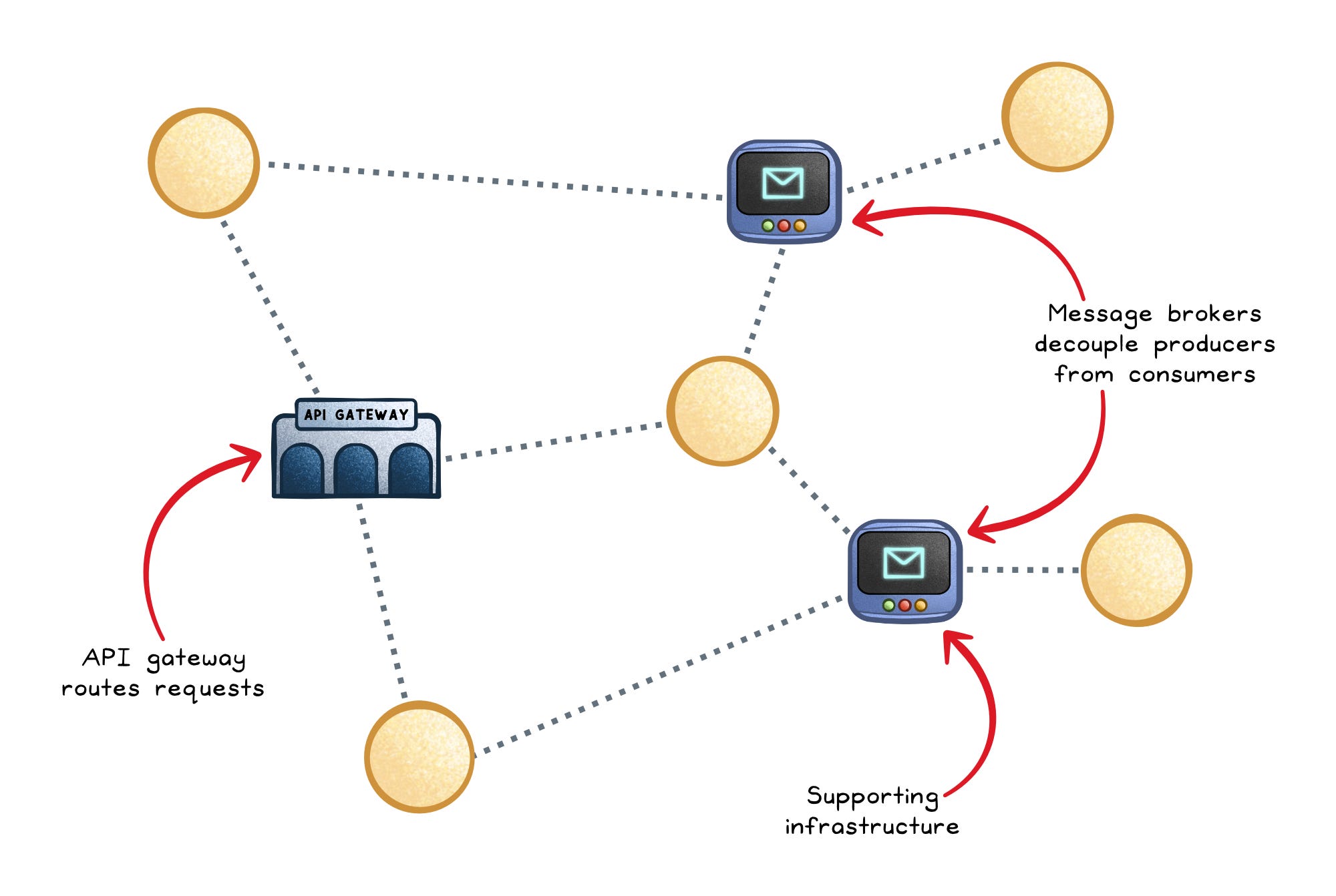
The result feels less like a single application and more like a small distributed system inside your product. Every service is simple on its own. The complexity lives in the interactions.
That’s the trade: you break one big problem into many small ones, and then you have to make them cooperate reliably.
Benefits
Microservices solve real problems when systems and teams reach a certain scale.
Independent scaling → Hot paths can scale without dragging the entire system along, which avoids over-provisioning and wasted resources.
Faster deployment → Teams ship changes independently, reducing release coordination and lowering the risk of unrelated regressions.
Fault isolation → A failure in one service degrades part of the product instead of taking everything down.
Team autonomy → Small teams own services end-to-end, which reduces coordination overhead and increases delivery speed.
Technology flexibility → Each service can use the language, database, or runtime that fits its workload best.
These advantages come from the same source: strong boundaries.
The architecture makes it hard for teams to accidentally couple themselves together.
Tradeoffs
Those same boundaries introduce new costs that don’t exist in a monolith.
Distributed complexity → Network calls replace function calls, bringing latency, retries, and partial failures.
Operational overhead → CI/CD, observability, and deployment automation become mandatory rather than optional.
Testing difficulty → End-to-end behavior spans multiple services, making failures harder to reproduce and debug.
Data consistency challenges → Transactions across services require eventual consistency and compensating actions.
Duplication risk → Shared logic is harder to centralize, leading to repeated implementations across services.
Microservices don’t remove complexity. They move it from code structure into system behavior and operations.
When microservices make sense
Microservices are a solution to specific problems. Use them when those problems are real and persistent.
They fit best when you need:
Uneven scaling → Some features receive far more traffic than others
Frequent independent releases → Deployment speed matters more than simplicity
Clear domain boundaries → Business logic splits cleanly into services
Large or growing teams → Ownership needs to scale with people
Strict resilience requirements → Partial failure is preferable to total outage
In contrast, small teams, early-stage products, or stable problem spaces often benefit more from a modular monolith. You can enforce boundaries without paying the distributed tax upfront.
When not to use microservices
Microservices fail most often when they are used too early.
Avoid microservices when:
The product is early and still changing shape → Boundaries will shift, and splitting too soon locks in bad decisions.
The team is small → Coordination costs outweigh deployment benefits.
Operational maturity is low → Without strong automation and observability, failures become invisible and painful.
The problem is simple → A modular monolith is easier to build, test, and reason about.
Starting with microservices too early often slows teams down. Sometimes it’s best to build a well-structured monolith first, then extracting services only when pain points become obvious.
Wrapping up
Most successful microservice systems started as monoliths.
Not because teams were cautious; but because they were deliberate.
A well-modularized monolith teaches you where the real seams are. Microservices then become a response to proven pressure, not an architectural guess.
Split when the pain is undeniable and the boundary is obvious.
👋 If you liked this post → Like + Restack + Share to help others learn system design.
Subscribe to get high-signal, clear, and visual system design breakdowns straight to your inbox: